
Many people have been drawn to the field of CNC (Computer Numerical Control) woodworking by the attraction of precisely & controllably bringing complex designs to life. DIY CNC wood carving projects provide a fulfilling way to create one-of-a-kind & customized pieces for individuals with a creative spirit and a passion for tangible results. This investigation explores the fascinating field of do-it-yourself CNC wood carving, highlighting the variety of creative options and the process of turning raw wood into artistic expressions.
This formerly specialized craft has become more accessible with the introduction of desktop CNC machines, enabling enthusiasts and makers to experiment and create from the comfort of their own workshops. Fundamentally, the procedure entails using automated cutting to convert digital designs into tangible forms. From delicate embellishments to sturdy structural elements, all rendered in the warm, organic beauty of wood, this fusion of digital design and mechanical precision opens up a world of creative possibilities.
The digital design is the cornerstone of every successful CNC wood carving project. CNC depends on painstakingly created digital blueprints, in contrast to traditional hand carving, where the artist’s hand directly manipulates the material. This fundamental change creates new opportunities for scale, complexity, & repeatability. Unlocking creative potential requires an understanding of the fundamentals of digital design specifically for CNC machines.
Transforming Concepts into Machine-Readable Formats from Sketch to Vector. A simple sketch or even a mental image is frequently the first step in the process of turning an idea into a CNC-ready design. However, a design must be converted into a vector format in order for a CNC machine to understand and carry out the design. Vector graphics allow for infinite scalability without sacrificing quality because they are mathematical representations of lines and curves. Raster graphics, such as JPEGs or PNGs, on the other hand, are pixel-based and may become pixelated when enlarged.
Sicher, hier ist der Satz mit dem klickbaren Link:
Ich bin daran interessiert, mehr über CNC-Maschinen für die Holzschnitzerei zu erfahren, die Sie unter hier.
Illustrator and Inkscape: The industry standard for producing vector artwork is software such as Adobe Illustrator (commercial) and Inkscape (free & open-source). These programs allow users to import pre-existing graphics, draw directly within them, or transform them into vector outlines. CAD Software for Precision: Computer-Aided Design (CAD) software is frequently used for more geometrically precise projects, such as functional parts or complex joinery.
Robust tools for producing 2D sketches and extruding them into 3D models are provided by programs like Fusion 360, SketchUp, or TinkerCAD. Tracing & Digitizing: It is frequently possible to digitize existing artwork, even hand-drawn pieces. Usually, this entails scanning the artwork & then tracing over the lines with software to turn them into vector paths. This process gets easier the cleaner and sharper the original. Knowing Toolpaths: The CNC Machine’s Language.
Creating “toolpaths” is a crucial next step after a design is produced in a vector or 3D format. The CNC machine’s cutting tool (router bit, end mill, etc.) is guided by these exact instructions. where to go, how fast, and how deep. The design and user-specified parameters are converted into these toolpaths by CAM (Computer-Aided Manufacturing) software.
2D vs. Carving in three dimensions.
2D carving is the process of making engraved designs, outlines, or profiles by cutting along vector lines.
For signs, ornamental inlays, or plain text, it’s perfect. Here, “V-carving” (using a V-shaped bit to create different depths based on line width) and “profile cuts” (cutting around the outline) are common toolpaths.
3D Carving: This is the area where CNC wood carving truly excels. It entails using 3D models to carve entire objects, sculpt surfaces, or make relief carvings.
This calls for more intricate toolpath techniques like “volumetric clearing,” “contour passes,” and “parallel passes.”. The “. Depth and Stepover: The depth of cut, or the amount of material removed in each pass, & the stepover, or the space between subsequent passes of the cutting tool, are important factors in toolpath generation. These settings have a big effect on the cutting tool’s wear, carving time, and finish quality.
Pocketing and engraving. Pocketing: This toolpath technique is used to extract material down to a predetermined depth from enclosed spaces, or pockets. It’s ideal for removing the background of a design or for making recessed spaces for inlays. Engraving: In order to produce exact etched details, engraving toolpaths are made to follow vector lines, much like V-carving. Wood Selection: Material Considerations for CNC Projects.
The final look and the carving process are greatly influenced by the wood selection. The densities, grain patterns, and hardness of various wood species affect how they respond to a CNC bit. Softwoods (Pine, Cedar, Fir): These are great options for novices because they are typically less expensive and simpler to carve. They might not hold fine details as well as hardwoods, though, and they can be prone to tear-out, particularly with intricate details.
Hardwoods, such as oak, maple, cherry, & walnut, are denser, more resilient, and provide better detail retention and a more elegant finish. They can be harder to carve, requiring slower feed rates & sharper bits. They are frequently perfect for showcase pieces due to their inherent beauty. Plywood & MDF: Medium-Density Fiberboard (MDF) and plywood are not conventional carving woods, but they can be utilized for specific projects.
Plywood can create intriguing layered effects, & MDF works well for smooth, painted surfaces or structural elements because it is uniform & simple to machine. But MDF can produce a lot of dust, & that dust is bad for breathing. Exotic Woods: Exotic woods can be investigated for genuinely original projects.
They can add a WOW factor with their vivid colors & unique grain patterns, but they are frequently more expensive and may need specialized tools. The actual creative process starts once the design and machine parameters are established. There are many uses for do-it-yourself CNC wood carving projects, ranging from purely artistic expressions to useful objects with decorative touches. For makers, the capacity to precisely duplicate designs, construct intricate interlocking components, and produce reliable outcomes opens up a world of opportunities. Adding Dimension and Depth with Decorative Relief Carvings.
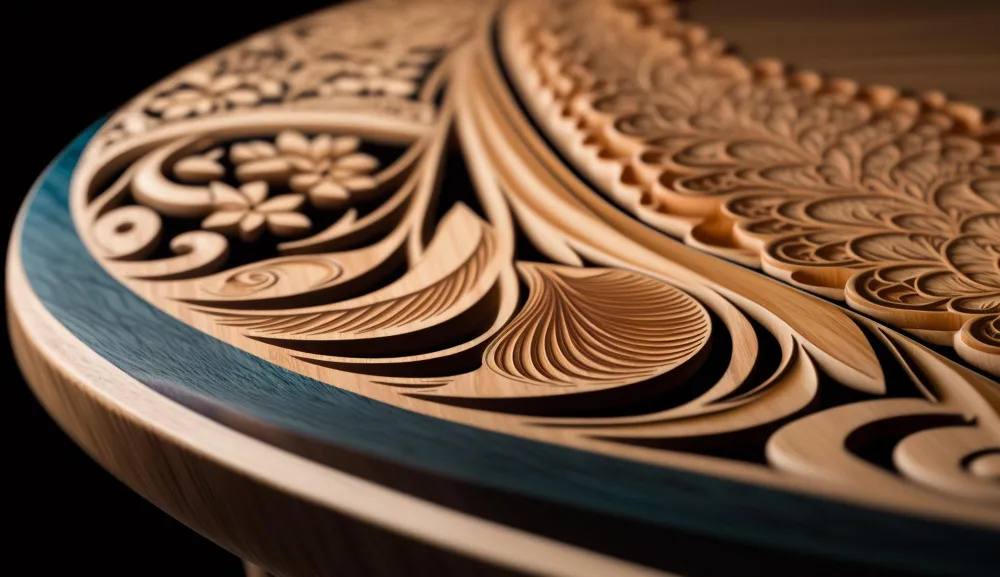
A distinguishing feature of CNC wood carving is relief carving, in which the design is elevated from a flat background. The ability to precisely control depth makes it possible to produce amazing three-dimensional effects that give patterns & images life. Wall Art and Plaques: To create striking wall décor, wooden panels can be carved with intricate landscapes, portraits, geometric patterns, or motivational sayings. The carving’s depth can vary from delicate embossing to rich, sculptural relief. Furniture Embellishments: The aesthetic appeal of furniture can be improved by adding carved decorative elements.
Consider decorative friezes for shelves, carved panels for cabinet doors, or elaborate table legs. Signage with Character: CNC enables the production of incredibly intricate and multidimensional signs for establishments, residences, or events, going beyond simple engraved text. Imagine a sculpted, realistic-looking logo that is carved. Practical Designs with a Creative Flare: Where Beauty and Utility Collide. Beyond just ornamental objects, CNC wood carving has many uses.
It makes it possible to incorporate complex designs into useful items, skillfully fusing functionality and creativity. Custom Jigs and Fixtures: Although not always aesthetically pleasing, CNC precision can be used to produce highly functional custom jigs and fixtures for other woodworking projects, improving repeatability and accuracy. Inlaid Designs: For accurately milling out recesses for inlay work, CNC machines are ideal. In order to create eye-catching visual contrasts, this can involve contrasting wood species, metals, or even resin.
Box and Container Designs: CNC can produce exquisitely detailed and useful containers, such as jewelry boxes with elaborate lid carvings or specialized storage containers with customized motifs. Musical Instruments & Accessories: CNC can be used to carve decorative elements, soundhole rosettes, pickguards, or custom cases for guitars, violins, and other instruments, even though the complete construction of a musical instrument is complicated. Personalized Presents and Memorabilia: Bringing Happiness with Handmade Items. Making genuinely personalized gifts is one of the most satisfying parts of DIY CNC wood carving. Each piece is unique due to the ability to engrave names, dates, distinctive symbols, or even basic drawings. Engraved Cutting Boards: A thoughtful and useful present is a cutting board that has been personalized with a recipe, a family name, or a special date.
Custom Coasters: Coaster sets with unique patterns, monograms, or themed imagery are great small presents or party favors. Shadow Boxes and Display Cases: Make one-of-a-kind shadow boxes or display cases with carved designs to display treasured collectibles, photos, or mementos. Wooden Toys with a Personal Touch: Customized wooden toys with engraved names or unique designs can turn into priceless family heirlooms. Tessellations and Geometric Wonders: Using Accuracy to Create Complex Patterns. Complex geometric designs and tessellations—patterns that repeat and interlock without gaps or overlaps—are perfect for CNC machines because of their inherent precision.
Parametric Designs: Designs that can be readily altered by altering a few crucial parameters can be produced using software that supports parametric design. This works great for creating a wide range of geometrically intricate patterns. Tessellating Art: A CNC can precisely cut interlocking shapes that fit together to create complex, eye-catching tessellations that cover a surface with repeating motifs.
3D Geometric Sculptures: CNC can carve intricate 3D geometric shapes in addition to 2D patterns, producing captivating sculptures with crisp lines and sharp edges. Wood is brought to life through interactive and dynamic projects. For the more daring do-it-yourselfers, CNC can be used to make wooden projects that are interactive and even kinetic, in which the wood itself is integrated into a moving or responsive system. Puzzle Boxes and Mechanical Toys: Create and cut the exact parts needed for complex wooden puzzles or mechanical toys that need interlocking parts.
Kinetic Sculptures with Wooden Elements: CNC can produce the unique wooden parts needed for larger kinetic sculptures, such as precisely carved moving parts, interlocking cams, or gear teeth. Starting your own DIY CNC wood carving projects is an ongoing learning experience. To get the best results and push creative boundaries, the maker still needs to grasp the subtleties of the craft even though the machine takes care of the precision. The unsung hero of a clean carve is material preparation.
Although it is frequently disregarded, proper workpiece preparation is essential for a successful and clean carve. Tear-out, uneven cuts, & damaged tooling can result from skipping this step. Flattening and Squaring: It’s critical to make sure the wood’s surface is perfectly flat & that its edges are square to the surface. A steady starting point is essential for CNC machines. For smaller pieces, a surfacing bit on the CNC itself can be utilized, or a jointer and planer are very helpful.
Securing the Workpiece: A workpiece that is securely held cannot be compromised. The project will be ruined if there is any movement while carving. Depending on the project & machine capabilities, use a vacuum table, double-sided tape, clamps, or screws. Dust control: CNC routers produce a lot of fine wood dust. In addition to keeping dust from interfering with the cutting process, efficient dust collection is essential for the machine’s longevity and the operator’s health.
The Sharp Edge of Creativity: Choosing and Maintaining Tools. The direct interface between the digital design and the wood is the cutting tool, which is typically an end mill or router bit. For any carving project to be successful, its type, sharpness, and condition are essential. Different kinds of bits.
End mills are common cutting instruments that remove material using flutes. They are available in a range of sizes & shapes, including flat, ball nose, & V-groove. V-groove bits are ideal for decorative engraving, while ball nose end mills are necessary for 3D carving. Router Bits: Certain CNC machines can use particular router bits for specific applications, even though they are frequently used in hand routers. Sharpness is crucial because a dull bit will cause tear-out, burned wood, and more machine stress. Make sure the bits are regularly inspected, replaced, or professionally sharpened.
Bit Coatings and Materials: Bits can be composed of solid carbide, high-speed steel (HSS), or have specific coatings. For wood, carbide bits are typically chosen because of their durability and hardness. Accepting the Learning Curve: Iterative Design & Test Cuts.
The editability of digital design is what makes it so beautiful. Don’t be scared to make changes to your designs based on preliminary findings or test cuts. Small-Scale Prototypes: Take into consideration creating a smaller test cut on scrap material before committing to carving a large or costly piece of wood. This enables you to review your overall design, depths, and toolpaths.
Toolpath Simulation: Before the toolpath is sent to the machine, the majority of CAM software has a simulation feature that shows it visually. This is a great method for identifying possible mistakes or collisions. Fine-Tuning Parameters: Feed rates, spindle speed, and depth of cut may need to be slightly modified for each type of wood and project. Be ready to adjust your settings after you’ve learned to spot the indicators of ideal cutting. Adding the final touches to improve the carved piece.
The finishing process highlights the full beauty of the wood and the carved details once the carving is finished. Sanding: To get rid of any fuzzies or minor flaws that the cutting tool may have left behind, a light sanding is necessary. For a smooth finish, start with a coarser grit and gradually switch to finer grits. Staining and Oiling: Stains can add a desired color or accentuate the wood’s inherent grain. Oils seep into the wood to provide protection and a natural sheen.
Clear Coats & Lacquers: Applying clear coats or lacquers can result in a finish that is more resilient & protective. These provide different degrees of gloss as well as resistance to wear & moisture. Painting & Patina: Painting the carved piece can produce eye-catching visual effects for some projects. Also, woodizers or patinas can be used to give an aged appearance and depth.
A growing community of makers and technological advancements are driving constant change in the DIY CNC wood carving landscape. The future of this creative endeavor is being shaped by enhanced software, increased accessibility, and a wealth of shared knowledge. CNC Hardware Improvements: Increased Power, Accuracy, and Cost-Effectiveness. The machines themselves are getting more advanced, providing improved features, bigger workspaces, and increased accuracy at more affordable prices.
Higher Spindle Power & Speed: More powerful spindles enable quicker cutting and more effective handling of harder woods. Better Linear Motion Systems: Cleaner cuts and finer details are produced by improved linear rails & bearings, which enable smoother movement and increased accuracy. Integrated Dust Collection: The workspace is safer and cleaner thanks to the more efficient & integrated dust collection systems that newer machines frequently have.
Affordable Entry-Level Options: More enthusiasts are now able to experiment with this craft because entry-level CNC machines are more dependable & capable. Software innovations include sophisticated toolpathing & intuitive design. Rapid advancements are also being made in the software used to design and operate CNC machines, making it more robust and user-friendly. User-Friendly CAM Software: Many CAM programs now provide guided workflows & simplified interfaces, making toolpath generation more accessible to novices.
AI-Assisted Design: New AI tools are beginning to help with design by making recommendations for patterns, refining layouts, & even creating original design elements. Cloud-Based Design & Simulation: Cloud platforms are facilitating more cooperative design procedures as well as robust simulation features that can be accessed from any device. Open-Source Software Development: The ongoing advancement of open-source design and CAM software provides makers with strong, cost-free options that encourage creativity and personalization.
The Expanding Internet Community: Exchange, Education, and Motivation. The active online community is arguably one of the biggest forces behind advancements in do-it-yourself CNC wood carving. A rich environment for learning and inspiration is being created by makers who are actively sharing their projects, methods, and expertise. Online Forums and Groups: Websites such as Reddit, Facebook groups, and specialized woodworking forums give makers a place to share their successes & failures, ask questions, and get advice. YouTube Tutorials and Demonstrations: Learning by watching is now simpler than ever thanks to the extensive collection of YouTube channels that provide in-depth tutorials, project walkthroughs, and demonstrations of particular techniques. Project Sharing Platforms: By documenting their creations from inception to completion, makers can inspire others with their inventiveness on websites devoted to sharing do-it-yourself projects.
Open-Source Project Repositories: By exchanging toolpath configurations and design files for particular projects, others can duplicate, modify, and expand upon previously created works. DIY CNC wood carving projects are an exciting and dynamic way to combine technology & creativity. The process involves constant exploration and artistic expression from the first spark of an idea to the fulfilling completion of a carved masterpiece. The possibilities for what can be accomplished with CNC wood carving are practically endless, providing a potent and fulfilling way to realize creative visions, one finely carved detail at a time, as technology develops and the maker community expands.
.
A DIY CNC wood carving project involves using a computer numerical control (CNC) machine to carve designs, patterns, or shapes into wood. This can be done using a pre-designed template or by creating a custom design using computer software.
Materials needed for a DIY CNC wood carving project include wood blanks, CNC carving bits, and sandpaper. Tools required may include a CNC machine, computer with design software, clamps, and safety equipment such as goggles and dust masks.
Popular DIY CNC wood carving projects include creating custom signs, carving intricate patterns or designs into wooden furniture, making decorative wall art, carving personalized gifts such as cutting boards or coasters, and creating custom wooden jewelry.
DIY CNC wood carving projects allow for precise and intricate designs to be carved into wood, providing a professional and polished look. It also allows for customization and personalization of wood items, making them unique and one-of-a-kind.
Safety considerations for DIY CNC wood carving projects include wearing appropriate safety gear such as goggles and dust masks, ensuring the work area is well-ventilated, and following proper machine operating procedures to prevent accidents or injuries.


 English English
 العربية
 Bahasa Indonesia
 ไทย
ไทย Deutsch
 Русский
 Español
 Nederlands
 Italiano
 Tiếng Việt
 Português do Brasil
 Français
 Dansk
Dansk Xhosa
Xhosa 日本語
日本語 香港中文
香港中文