
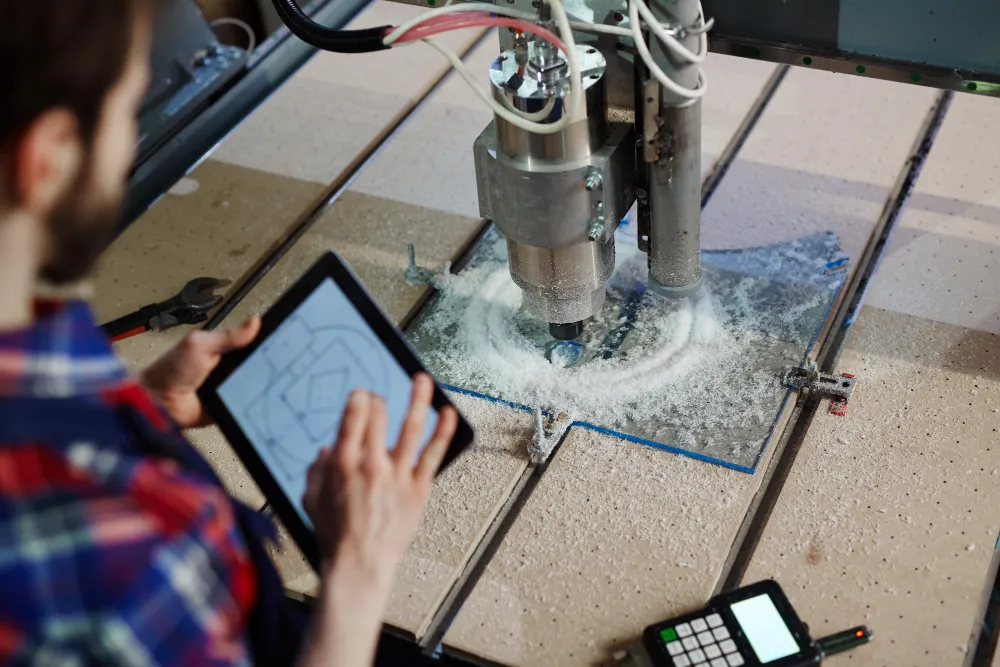
Computer Numerical Control (CNC) technology is essential to the complex fields of manufacturing & artistic creation. A subset of this technology called CNC carving enables artists to convert digital designs into physical objects with unmatched precision and consistency. But the real potential of CNC carving is found in the advanced software that controls the machines’ movements, not just in the machines themselves. Optimizing accuracy with CNC carving software is a complex process that calls for a thorough comprehension of its features and a methodical approach to its use.
The first step in optimizing precision is to fully understand the fundamental ideas and features of the program. Every cut, plunge, and traverse is dictated by this CNC machine’s digital brain, which converts human intent into machine-readable instructions. CAD/CAM Integration’s Function. The majority of the time, CNC carving software functions as an integrated CAD/CAM (Computer-Aided Design/Computer-Aided Manufacturing) system, or at the very least, facilitates smooth communication between different CAD and CAM packages.
For precise design, use CAD. The first step is to conceptualize & digitally engineer the desired object using computer-aided design (CAD) software. At this point, accuracy is crucial because any errors or ambiguities will affect the workflow as a whole.
Users need to concentrate on the following. Dimensional Integrity: Making sure all measurements are precise and within predetermined tolerances. Radii, angles, and depths must all be precisely defined. Creating clear and unambiguous geometries is known as geometric fidelity. Errors in the ensuing CAM phase can result from overlapping lines, open contours, or self-intersecting surfaces. Material Considerations: If applicable, take into account the expansion or shrinkage of the material in the design, particularly for metals or plastics that are subjected to large temperature changes.
بالتأكيد، إليك الجملة مع الرابط القابل للنقر:
CAM for Optimizing Toolpaths. The 3D model from the CAD stage is converted by Computer-Aided Manufacturing (CAM) software into G-code, which the CNC machine can understand. Determining the toolpaths—the exact paths the cutting tool will take—is an essential step in this process. Toolpath Strategies: Certain toolpath strategies are needed for various carving tasks. While finishing operations might use spiral, raster, or contouring paths, roughing operations might use parallel cuts or pocketing.
Surface finish & dimensional accuracy are directly impacted by selecting the best approach. The selection of a cutting tool (e.g. “g.”. V-bits, end mills, and ball nose bits) have a major impact on precision. To match the material being carved and the intended detail, factors like diameter, flute count, and material composition must be carefully taken into account.
Two crucial machining parameters are spindle speed, or how quickly the tool rotates, and feed rate, or how quickly the tool passes through the material. Because of material deflection or overheating, improper settings can result in dimensional errors, poor surface finish, or tool breakage. Formats for Data Input & Output.
Precision depends on the smooth transfer of data between various software programs. It is essential to comprehend common file formats. Raster and vector information. For carving in 2D and 2.5D, vector data (e.
A g. is favored because of its mathematical accuracy (DXF, SVG, AI). Raster information (e.g. The g. JPG, PNG) are pixelated by nature, making them less appropriate for direct carving unless they are converted and vectorized, which may add some approximation.
3D Model Structures.
Formats like OBJ (Wavefront OBJ), STEP (Standard for the Exchange of Product model data), and STL (Standard Tessellation Language) are frequently used for real 3D carving. Despite being widely used, STL represents surfaces as a mesh of triangles, and the mesh density determines how accurate it is. Larger file sizes but more accurate representation are the results of higher density. A more reliable and accurate representation of solid models is provided by STEP files. Beyond basic comprehension, a number of sophisticated techniques in CNC carving software can greatly increase precision.
improving machining operations & toolpaths. The accuracy & surface quality of the finished product are directly impacted by how toolpaths are created and implemented. Roughing and adaptive clearing. Adaptive clearing techniques are available in modern CAM software, which dynamically modifies the toolpath in response to material engagement. This technique keeps the chip load constant while lowering tool wear, increasing material removal rates, and creating a more uniform surface finish even during roughing, all of which help with finishing passes. A smoother roughing pass results from a consistent chip load, which reduces chatter and stops tool deflection.
Decreased Stress on Tool: Increases tool longevity and lowers the chance of breakage, particularly for small or delicate tools. Higher precision is achieved by removing more uniform material, which leaves less material for the finishing pass. Stepover Control and Finishing Methods. The final details and surface quality are attained during finishing operations. The choice of finishing technique and careful control over stepover—the space between subsequent cutting tool passes—are crucial.
Contour versus. Raster Finishing: Contour finishing, which adheres to the model’s contours, frequently produces a more visually appealing finish on curved surfaces. Parallel passes are used in raster finishing, which can be quicker but may cause visible tool marks on some geometries. Fine Stepover: Although it takes longer to machine, a smaller stepover significantly enhances surface quality and dimensional accuracy.
Optimizing the relationship between stepover, tool diameter, and intended surface roughness is essential. Z-Level Finishing: Z-level finishing guarantees accurate depth control at every layer in layered designs, which is essential for complex 3D carvings. Ramp Optimization and Lead-in/Lead-out. Surface quality and tool life can be affected by how the tool enters and leaves the material as well as how it descends to depth.
Smooth Ramps: Ramping into the material instead of plunging vertically lessens shock to the machine and tool, preventing deflection and enhancing the quality of the initial cut. Lead-in/Lead-out Arcs: To avoid sudden direction changes that could leave witness marks on the workpiece, use tangential arcs for lead-in and lead-out moves. Material-Specific Factors. Heat and cutting forces have different effects on different materials. The parameters of CNC carving software can be adjusted to fit particular materials.
Hardwoods versus. gentle woods. Woods (e.g. (g). Softwoods (e.g., oak, maple) typically need higher spindle speeds and slower feed rates to avoid tear-out and burning. “g.”.
pine, cedar) are more likely to chip even though they can withstand higher feed rates. Composites & Plastics. Heat produced by friction must be carefully managed when carving plastics to prevent gumming or melting. Specialized instruments with polished flutes & particular shapes are frequently used.
Composite materials (e. (g). To avoid delamination and excessive tool wear, materials like carbon fiber and fiberglass require very sharp tools & frequently special coatings. metal. Robust tools, precise control over chip evacuation to avoid re-cutting and heat buildup, and coolant strategies (often managed by CNC software) are all necessary when machining metals. Both verification & simulation. Virtual simulation of the carving process is an essential step for optimizing precision prior to investing valuable material and machining time.
Visualization of Toolpaths. The majority of CNC carving software offers advanced toolpath visualization, which enables users to see the precise path the tool will take. This aids in spotting possible collisions, ineffective motions, or places where the tool might not function as planned. Material Removal Simulation. A realistic preview of the final carved object is provided by sophisticated simulation tools that render the material as the cutting tool would remove it. This makes: possible.
Finding situations in which a tool or tool holder may collide with clamps, fixtures, or the workpiece itself is known as collision detection. Residual Material Analysis: Emphasizing regions where an excessive amount of material remains or where a feature hasn’t been completely cleaned out by the tool. Predicting the final surface quality based on the selected toolpaths & machining parameters is known as surface finish prediction. G-code confirmation. Errors that may not be visible in graphical simulations can be found by directly comparing the generated G-code to the original CAD model.
Certain programs can even carry out “back-plotting,” which allows for an exact comparison with the intended design by using the G-code to regenerate the toolpaths. Even with ideal software settings, the CNC machine’s physical reality necessitates ongoing attention to details like intelligent post-processing & calibration. Machine Configuration & Calibration. The calibrated state of the CNC machine itself plays a major role in precision; it is not just a software function.
Spindle Tramming and Runout. To achieve consistent cut depths & avoid tapered holes or uneven surfaces, it is essential to minimize spindle runout (wobble) and make sure the spindle is precisely perpendicular to the work surface (tramming). Software can help by offering calibration procedures or assisting the user with the tramming procedure. Calibration of axes.
Accurately calibrating the X, Y, & Z axes guarantees that movements match the specified distances. Accurate positioning also depends on backlash compensation, where the software takes mechanical play in the lead screws into account. Clamping and fixturing of workpieces. A key factor in accuracy is how the workpiece is fastened.
Inaccuracies will result from any movement made while carving. Software can help with clamping strategy optimization to increase rigidity or custom fixture design. The machine interface and post-processing.
Between the CAM software and the particular CNC machine controller, the “post-processor” serves as a link. It converts the generic toolpath data into the exact dialect of G-code that the machine can understand. Post-processors that are unique.
Custom post-processors made to meet the specific needs & capabilities of a specific CNC machine & its controller are advantageous for many high-precision applications. This guarantees that features like tool changers, rotary axes, & particular spindle commands are correctly interpreted. Managing errors & optimizing code. A well-thought-out post-processor can incorporate error-checking procedures to avoid common errors and optimize the generated G-code for machine efficiency. The following are included.
Eliminating superfluous commands that could impede processing is known as “redundant code removal.”. Arc-to-Line Conversion: For older controllers that might have trouble with accurate arc interpolation, this technique transforms complicated arcs into a sequence of brief linear moves. Machine-Specific Warnings: Notifying the operator of possible problems prior to machining.
The skill and experience of the human operator are still crucial for optimizing precision, even with the power of software. Constant Learning and Flexibility. CNC carving software is a field that is always changing.
In order to stay up to date with new features, software updates, & best practices, operators must make a commitment to lifelong learning. New features and software updates. Updating the software on a regular basis guarantees access to the most recent algorithms, toolpath strategies, and bug fixes—many of which include enhancements in accuracy and efficiency.
Community Involvement. By taking part in online forums, user groups, and training workshops, operators can solve problems, learn from the experiences of others, and find new methods for precision machining. diagnosing and fixing issues. Unexpected problems can occur even with the best machine and software. The capacity to identify issues and find effective solutions is essential. determining the underlying causes.
When precision problems arise, the operator must carefully examine every step of the process, from design to toolpath creation to machine execution, in order to identify the underlying cause. Checking design files, tool definitions, machining parameters, or machine calibration may be necessary for this. Refinement iteratively. It is frequently an iterative process to reach ultimate precision.
Operators must be ready to make minor changes, test them, evaluate the outcomes, & improve their strategy until the required degree of accuracy is attained. Using CNC carving software to maximize precision is a comprehensive process that combines sophisticated software features with careful machine setup & the operator’s priceless knowledge. Through a thorough comprehension of CAD/CAM principles, the use of sophisticated toolpath strategies, meticulous operation simulation, and flawless machine calibration, creators can push the envelope of what is feasible and accurately translate digital visions into physical realities. CNC carving software is a vital tool for contemporary manufacturing & artistic expression, & its continued development promises even more control and precision.
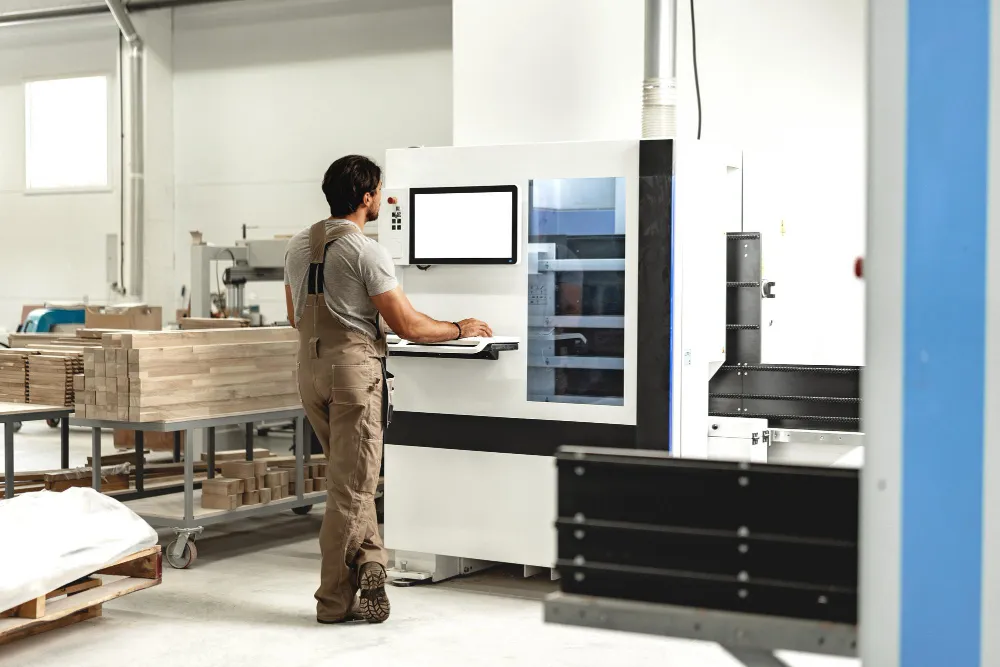
CNC carving software is a computer program used to create designs and toolpaths for CNC (Computer Numerical Control) carving machines. It allows users to design and manipulate 3D models, generate toolpaths, and control the carving process.
CNC carving software works by allowing users to import or create 3D models, define toolpaths, and generate G-code instructions that the CNC machine can understand. The software provides a user-friendly interface for designing and controlling the carving process.
CNC carving software typically includes features such as 3D modeling tools, toolpath generation, simulation capabilities, material and tool libraries, and compatibility with various CNC machines. Some software also offers advanced features like automatic toolpath optimization and multi-axis machining.
Using CNC carving software allows for precise and efficient carving of complex designs, reduces the risk of errors, and enables the production of intricate and detailed carvings. It also streamlines the design and production process, saving time and increasing productivity.
Some popular CNC carving software options include Vectric Aspire, Autodesk Fusion 360, ArtCAM, and Easel by Inventables. These software packages offer a range of features and capabilities to meet the needs of different users, from hobbyists to professional woodworkers and manufacturers.


 English English
 العربية
 Bahasa Indonesia
 ไทย
ไทย Deutsch
 Русский
 Español
 Nederlands
 Italiano
 Tiếng Việt
 Português do Brasil
 Français
 Dansk
Dansk Xhosa
Xhosa 日本語
日本語 香港中文
香港中文